
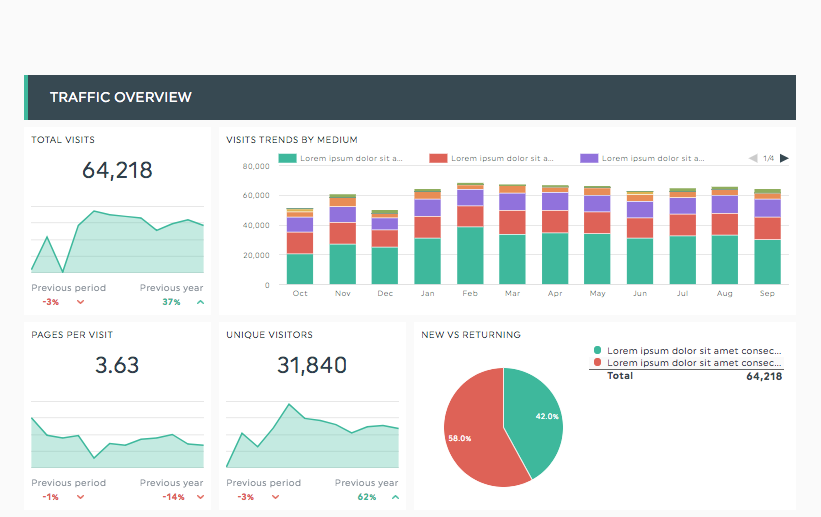
Our dashboards are automated which means that you never have to go from one marketing software to the other to fetch your data manually. What's great about automation? Your dashboards will be updated automatically every day!
What is included in a dashboard?
All your integrations
Integrations are the marketing platforms you use in your different marketing strategies and which you track in your dashboard. For example, Google Analytics 4, Google Ads, Facebook, Instagram, LinkedIn, SEMrush, or Mailchimp. There are 30+ integrations to choose from, and you can add them all to the same dashboard. If you have proprietary data you’d like to include, or if you use a marketing platform that’s not yet a DashThis integration, you can include this data with our CSV or Google Sheet.
All your accounts, views, sources, pages, profiles…
Not only can you gather data from multiple integrations, but if you need to track multiple sources, accounts, views, profiles, or pages in the same dashboard, no problem! For example, you could add your client’s 3 different Facebook pages and their 2 Google Analytics 4 views in one dashboard. You can also choose just one of their profiles, it’s up to you!
Different widget types
Widgets are your way of visually representing your data. With them, you can display all your KPIs in many different layouts, such as lists, historic trends, pie charts, simple numbers, and more. Need more info on our widgets? Check out our DashThis widgets explained
Preset Widgets
Preset widgets are the most commonly used metrics and/or KPIs for each of our respective integrations that our experts have created for you. They are very useful to save precious time and energy when creating your dashboard.
Custom Widgets
Custom widgets give you the opportunity to choose pretty much everything! These widgets can be entirely customized: the graph type, metrics, dimensions, and filters… you’re in control of everything. You decide exactly what data is displayed, and how!
Static Widgets
Static widgets allow you to add other pieces of information, such as comments, editable numbers, or headers to divide your dashboard into sections (like social media, SEO, and PPC). Comment widgets allow you to add images or signatures to your dashboard!
Widget Bundles
Bundles are designed to help you add multiple widgets at once from a specific digital marketing category such as Advertising, Conversions, Website Traffic, etc.
Calculated Widgets (Beta)
Calculated Widget allow you to combine multiple metrics from different integrations into a single value using mathematical operations such as addition (+), subtraction (-), multiplication (*), and division (/).
Features
Most of the features we offer are included in almost every dashboard plan, however, some limitations apply. Check out our pricing page to see what is included.
Here’s a quick overview of what’s included:
- Easy widget drag-and-drop feature;
- Dashboard sharing options;
- All our report templates;
- Customizable date ranges & flexible periods
- Cloning option;
- Comments and notes;
- And much more!
You also have access to our Support Team, who will answer all your questions the second you start your free trial!
How many dashboards do you need?
It all depends on what data you want to report on, to whom, and how. Each marketing agency and marketer has a different approach and creates different types of dashboards for his/her clients.
The most important thing to remember when calculating how many dashboards you need is that you can include data from all your marketing platforms (integrations) and multiple data sources (accounts, properties, pages, etc.) in a single dashboard.
👉 However, with DashThis’ source-based pricing, you should consider both:
- The number of dashboards
- The number of data sources you use across those dashboards
A data source is a connected account (for example: one Google Ads account, one GA4 property, or one Facebook page). Each source counts toward your plan when it is used in at least one dashboard.
Basically, you can create one dashboard with each client’s PPC, social media, and SEO data all together, or you can create one dashboard for each campaign. You can also create a dashboard for each department of your company, it’s really up to you!
Here are some examples to help you figure out how many dashboards and sources you might need:
Example 1:
You are a marketing agency with 25 clients. Each client needs one monthly report that includes 3 data sources (for example: Google Ads, GA4, and Facebook Ads).
-
Dashboards needed: 25
- Sources needed: 75
👉 The Business 25 plan includes 100 sources, so this setup fits within your plan.
If you decide to create 2 dashboards per client (for example: one SEO report and one PPC report):
- Dashboards needed: 50
- Sources needed: still around 75 (since sources can be reused)
👉 You would need the Enterprise 50 plan, which includes 200 sources, more than enough for your needs.
Example 2:
You are a marketing agency with 10 clients, and each client uses 3 social media platforms (LinkedIn, Instagram, Facebook).
- Dashboards needed: 10
- Sources needed: 30
👉 The Professional 10 plan includes 40 sources, so you're within the limit.
If you decide to add more data sources per client (for example: GA4 and Google Search Console):
- New total sources: 50 (10 clients × 5 sources)
👉 You will exceed the number of sources included in the Professional 10 plan, so you’ll need to upgrade to a plan that better matches your required number of sources.
Key takeaway
-
A dashboard is how you organize and present your data
- A source is where your data comes from
Each plan includes both dashboards and sources, so the key is to balance:
- How many dashboards you create
- How many unique data sources you connect
Planning both together ensures you choose the right plan, and avoid hitting your limits.
Still not sure how many dashboards you need? See for yourself! Try the tool for free!
Don’t worry, you don’t have to choose a plan just yet, and even if you do choose one, you can change it anytime!
Need help with your dashboard?
Contact our Support Team here 💪🏼
